Core drill hire for clean service penetrations
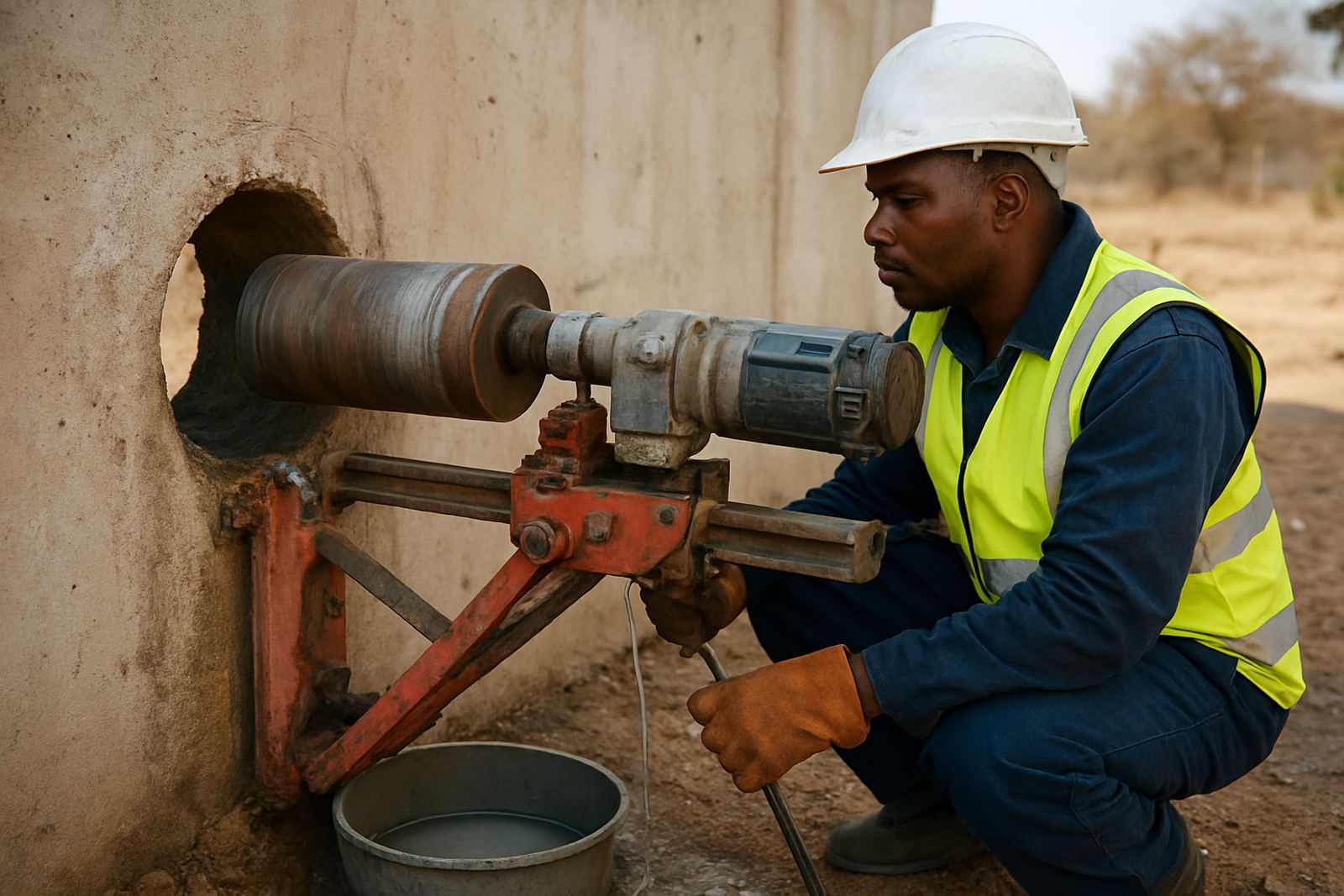
Core drills are used when a standard hammer drill will not give a clean enough opening. They cut a round core through reinforced concrete, brick, blockwork and stone, which makes them the practical choice for plumbing, electrical, HVAC and fire service penetrations. On active sites, neat holes matter because they reduce patching, keep finishes tidy and help contractors stay within the drawing sizes. If you are working in Germiston, Midrand, Durban or Cape Town, the same requirement applies: the hole must be accurate and the slab or wall must remain sound.
Our core drill hire is suited to contractors who need repeatable results and steady cutting performance. The equipment is selected for site use, not just light workshop work, so it handles dust, vibration and long operating hours better than basic hand tools. When required, we can also assist with matching the drill to the material, whether you are cutting a 50 mm opening for services or a much larger hole for ducts and sleeves.
- Neat circular holes with less breakout at the edges
- Suitable for vertical, horizontal and overhead drilling where safe and approved
- Useful for services, anchors, sleeves and test openings
- Works on concrete, brick, block and masonry substrates
Sizes, mounting options and bit selections
Core drills are hired with the right mounting setup for the job. Smaller units are often used for lighter penetrations and wall work, while larger rigs are chosen for thicker slabs and bigger diameter holes. Depending on the access and the surface, the drill can be set up as a handheld unit or mounted on a stand for more accurate alignment. Where the opening must stay straight through a slab or wall, a stand is usually the better option because it gives better control and less wander.
Bit choice is just as important as the drill itself. A diamond core bit is the standard option for hard material and reinforced concrete, while different segment styles suit different speeds and finishes. We stock practical sizes for site work, from small service holes through to larger openings for ducting, pipe sleeves and mechanical services. If you are not sure which size to order, give us the finished hole size rather than the pipe or conduit size only, because the cutter needs clearance too.
- Handheld and stand-mounted drilling options
- Common core bit diameters from 25 mm to 250 mm and larger on request
- Suitable for wet or dry cutting, depending on the material and site rules
- Extension bars and adaptors available where depth or access is limited
Where core drilling suits best on site
Core drilling is used across building, civil and maintenance work. It is common on new builds, plant rooms, refits, warehouse alterations and structural service routes. On Johannesburg sites, contractors often use it for slab penetrations in multi-storey work, while in coastal areas such as Durban and Cape Town it is also chosen because a clean cut helps reduce unnecessary damage to already finished surfaces. It suits jobs where a tidy opening is needed and where the position must line up with other trades.
The equipment is also useful in places where noise, dust and access need to be controlled. That includes occupied buildings, tight plant rooms, passageways and areas where the client expects a cleaner result than a breaker or chisel can give. For municipal or commercial work, it is often the preferred method when the drawing calls for a specific opening and the installer needs to avoid damaging reinforcement, finishes or nearby services.
- Electrical and data service penetrations
- Plumbing, drainage and sprinkler openings
- HVAC duct and pipe sleeves
- Structural sample cores and inspection openings
Power, water and site setup requirements
Before hiring, it helps to know what power is available on site. Many core drills run off standard 230 V supply, but larger units may need higher output or a dedicated circuit depending on the load. On projects where power is affected by load-shedding, a generator with the correct capacity may be needed. That matters especially if the work must continue during outages or if the drilling window is short. We can help you plan for that so the crew is not standing around waiting for power to return.
Wet drilling is often used on concrete because it controls dust and keeps the bit cooler. That means a water feed, safe drainage and proper housekeeping around the work area. Some sites may prefer dry drilling in certain conditions, but the material, hole size and location must suit it. For overhead work or sensitive finishes, make sure the setup allows for slurry control, splash protection and access to the workface. If the job is in a shopping centre, office block or a governed site, check the building rules first because some clients require dust suppression, noise control or written permission before any penetration starts.
- Confirm the available voltage and outlet type before ordering
- Check if a generator or extension leads will be needed
- Allow for water supply and slurry control on wet cuts
- Make sure the work area is clear of live services and hidden reinforcement
Care, handling and servicing on hire
Core drilling equipment performs best when it is handled properly. The drill must be kept upright where possible, the bit should not be forced, and the operator should allow the cutter to work at the correct speed. Too much pressure can overheat the segment, slow the cut and shorten bit life. If the bit starts glazing or the cut becomes slow, the problem is often feed pressure, water flow or the condition of the material rather than the machine itself.
Our fleet is checked before dispatch and serviced regularly so it arrives ready for work. That includes checking the drive system, mounting parts, switches, cables and the condition of the drill bit. Where needed, we can assist with on-site servicing or a swop-out if a unit develops a fault during hire. Keeping the equipment clean after use also helps, especially on coastal sites where moisture and salt air can affect metal parts faster than inland. A quick rinse, proper drying and safe storage go a long way.
- Do not jam the bit or side-load the drill
- Keep water flow steady on wet drilling jobs
- Clear slurry and dust before moving the equipment
- Report unusual vibration, burning smells or loss of cutting speed promptly
What to confirm when placing your order
To make sure you get the right unit first time, send through the hole diameter, material thickness and the number of openings needed. It also helps to know whether the drilling is on a wall, slab or overhead surface, and whether the area is internal, external or part of an occupied building. If there is rebar, tiles, waterproofing or a finished surface, mention that as well because it can change the bit selection and setup.
We also recommend confirming the site location, access conditions and the time window for work. Our Germiston, Midrand, Pretoria East, Boksburg, Durban, Pinetown, Cape Town and Bellville depots help us move equipment quickly across Gauteng, KwaZulu-Natal and the Western Cape. For longer jobs, weekend support and long-term hire can be arranged. If you need operator supply, safety documentation or a plant swop-out, let us know at the same time so the booking is sorted before the crew arrives on site.
- Finished hole size in millimetres
- Wall or slab thickness and material type
- Power available on site and need for generator support
- Wet or dry drilling preference and any site restrictions
Key facts
| Power supply | 230 V units available, with larger options for heavier duty drilling |
|---|---|
| Hole diameter range | Approx. 25 mm to 250 mm and larger sizes on request |
| Mounting options | Handheld and stand-mounted setups |
| Cutting method | Diamond core drilling for concrete, brick, block and masonry |
| Depth capability | Suitable for standard service penetrations and deeper cuts with extensions |
| Hire support | Site delivery, same-day dispatch, breakdown response and long-term hire |